How to extract specific pages from a PDF

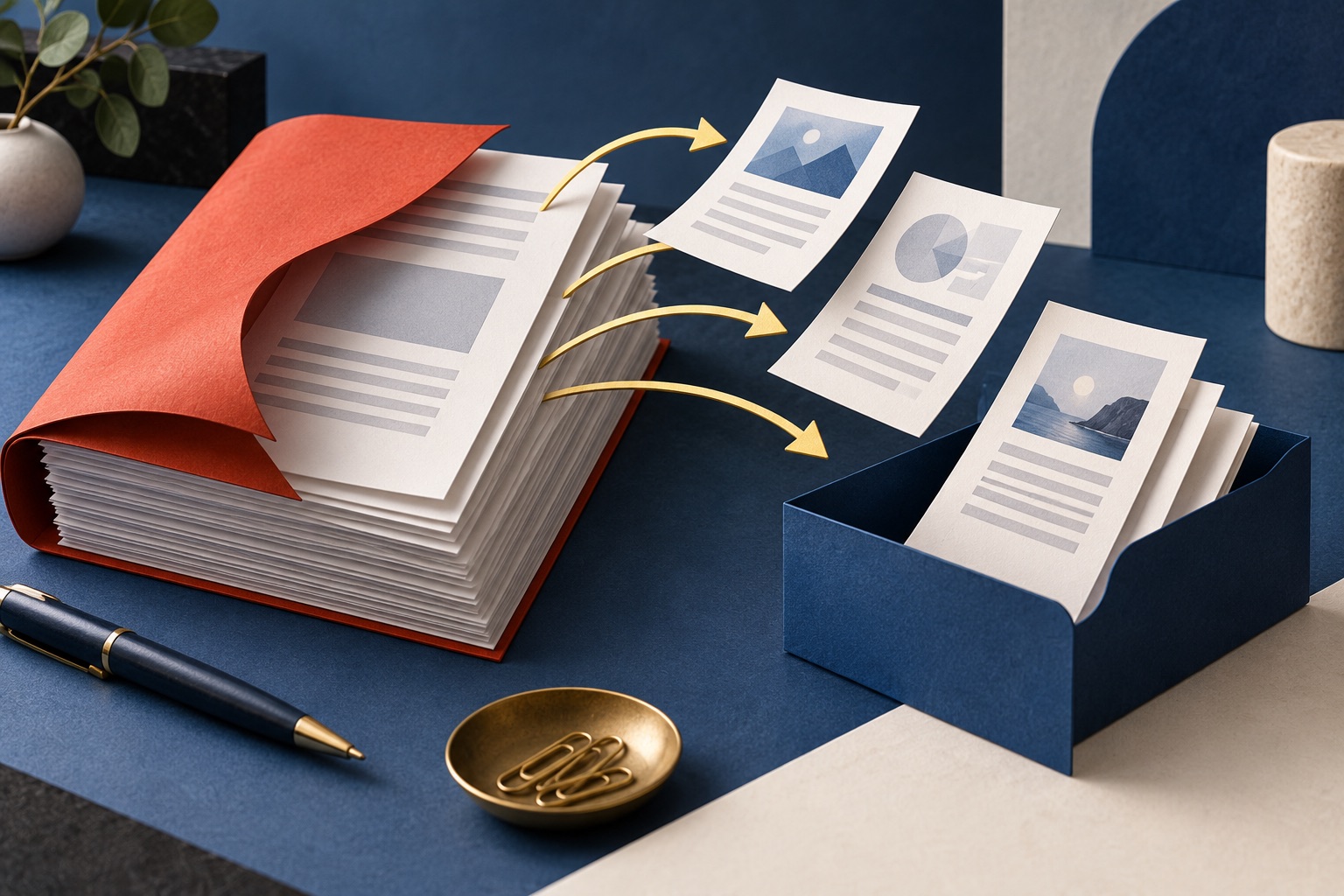
Extract pages from a PDF free in your browser: select the thumbnails you want or enter a range such as 4-9, then download a new PDF containing only those pages. The source file is unchanged. Extraction keeps your chosen subset in one file, unlike splitting, which creates multiple files.
See the tools in action
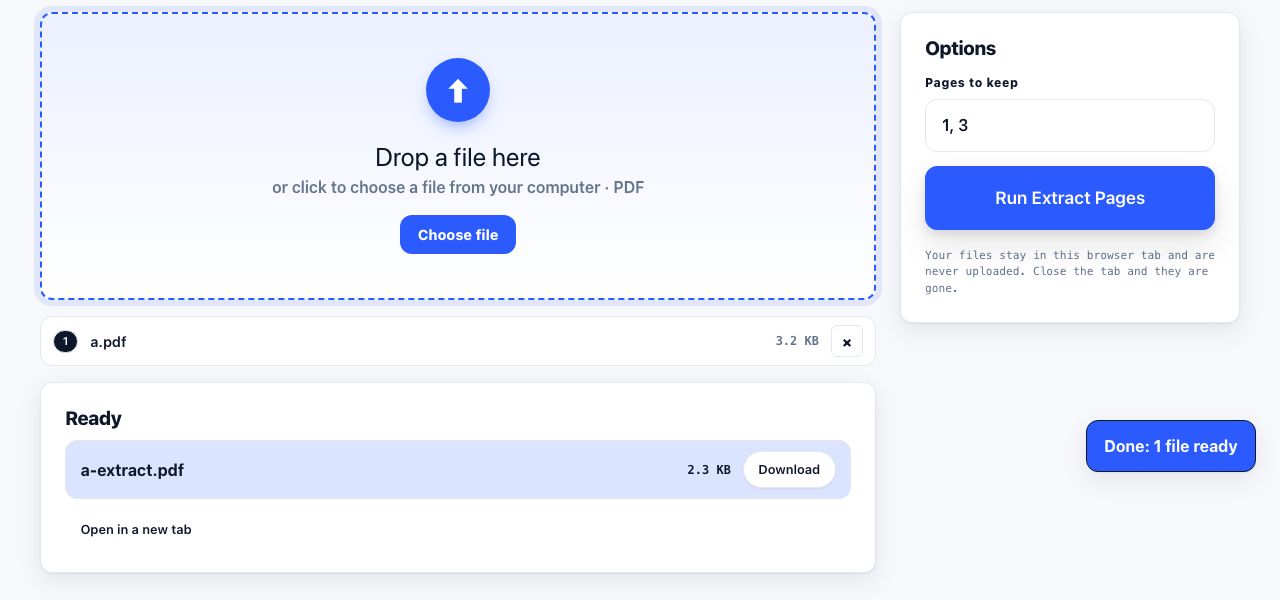
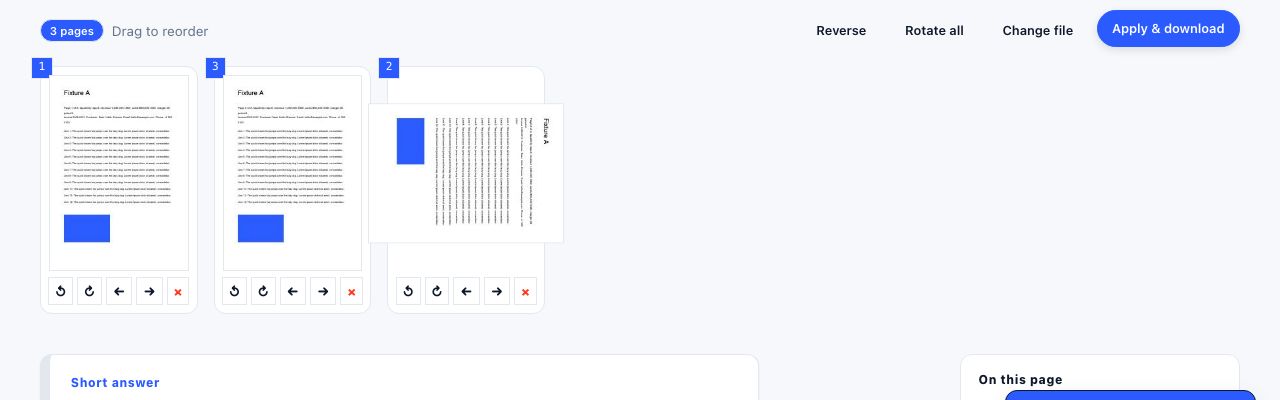
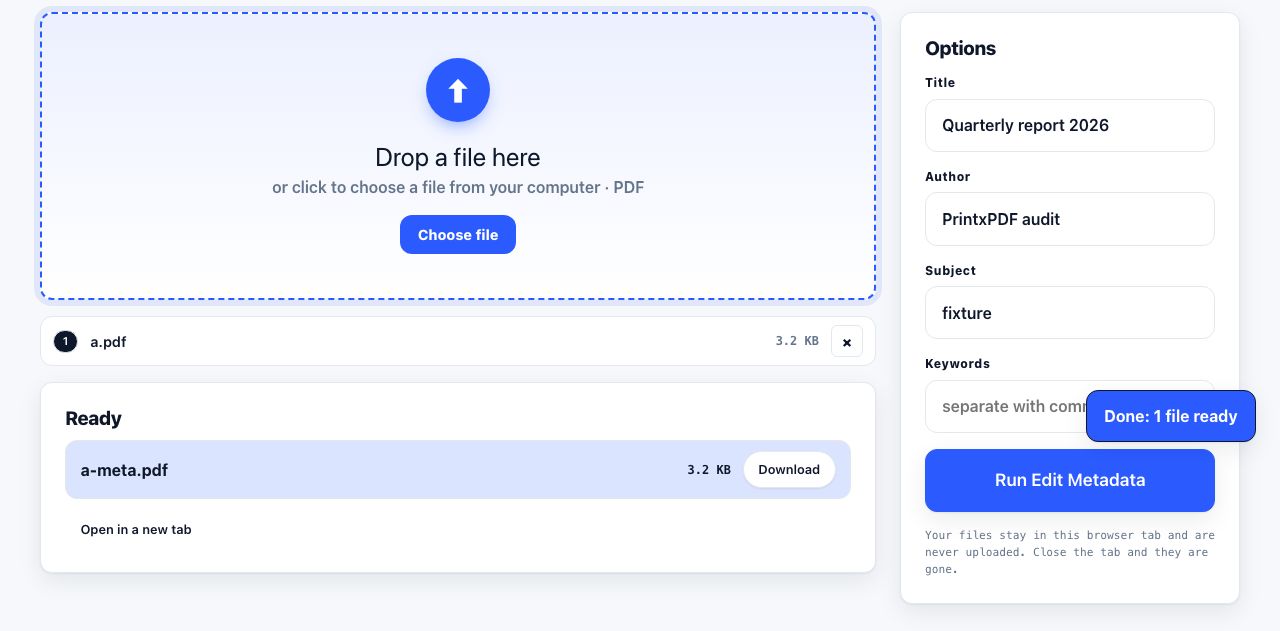
The three page operations get confused constantly, and choosing the wrong one is why people end up with 47 files they did not want. The distinction is simply what you are left holding.
| Operation | You specify | You get | Original |
|---|---|---|---|
| Extract | Pages 12-18 | One 7-page PDF | Unchanged |
| Split | Ranges or a chunk size | Several PDFs covering the whole document | Unchanged |
| Delete | Pages 12-18 | One 43-page PDF | Unchanged, you download a copy |
Extracting, step by step
- Open the extractorGo to extract pages and drop the PDF in. Every page appears as a numbered thumbnail.
- Select the pagesClick thumbnails to toggle them, or type a range such as
4-9or2,7,15-18. Selections do not have to be contiguous. - Decide on the output shapeChoose one combined file to keep the pages together in order, or one file per page if each page is going to a different place.
- Check the orderExtraction keeps the original document order regardless of the order you clicked. If you need a different sequence, extract first and then reorder.
- DownloadThe new file contains only the pages you chose. Nothing was written back to the source.
Pull out exactly the pages you need and keep the rest of the document intact.
Extract Pages →Things people actually extract
- The signature page of a long contract, to send back on its own instead of returning 60 pages.
- One chapter of a textbook or manual for a class, a meeting or a printout.
- A single invoice from a monthly statement batch that arrived as one file.
- The results section of a report, when the reviewer asked for the findings and not the methodology.
- One certificate from a batch generated for a whole cohort.
- The two pages that matter from a 120-page terms document, to quote in an email.
The print-to-PDF shortcut, and its cost
You can extract pages anywhere without a dedicated tool: open the PDF in any viewer, press Ctrl+P, type the page range, and choose Save as PDF as the destination. It works on every platform with no software at all.
The cost is that this re-renders the document rather than copying it. Compare the two routes before you use it for anything that matters.
| Extract tool | Print to PDF with a range | |
|---|---|---|
| Text stays selectable | Yes | Usually, but not guaranteed |
| Hyperlinks survive | Yes | No |
| Bookmarks survive | Yes, if they point into the kept range | No |
| Form fields stay fillable | Yes | No, they are flattened |
| Page size preserved exactly | Yes | Rescaled to the selected paper size |
| File size | Proportional to the pages kept | Often larger than the extracted portion |
| Available everywhere | Needs a tool | Yes, in every PDF viewer |
Print-to-PDF is a perfectly good way to pull one page out of a manual for a colleague. It is a bad way to extract a page from a fillable form, an accessible document, or anything with a table of contents you want to keep working.
macOS Preview and command line
On a Mac, show thumbnails with ⌥⌘2, ⌘-click the pages you want, and drag the selection onto the Desktop. macOS builds a new PDF from it. For repeatable work, qpdf is exact and scriptable:
# Pages 4-9 into a new file
qpdf report.pdf --pages report.pdf 4-9 -- section.pdf

# Non-contiguous: pages 2, 7 and 15-18
qpdf report.pdf --pages report.pdf 2,7,15-18 -- selected.pdf

# Pull the same page range out of every PDF in a folder
for f in *.pdf; do qpdf "$f" --pages "$f" 1 -- "covers/$f"; done
Extracting a page does not remove anything hidden on it. Text under a black box, content outside the crop box, comments, and hidden layers all travel into the new file. If the point of extracting was to share less, flatten the result and strip its metadata before sending it.
What comes with the pages
An extracted file inherits the source document's metadata: title, author, producer, and the creation date of the original rather than of your extraction. If you extracted a single page from a colleague's report, their name is now in your file's author field. Check it with edit metadata, which takes about ten seconds.
Bookmarks pointing at pages you did not keep are dropped or left dangling depending on the tool, and printed page numbers do not renumber, so an extracted range that starts at physical page 12 will still say 12 on the first sheet. If that is confusing for the reader, re-apply page numbers to the extract.
Extract, or delete the rest?
They reach the same place from opposite ends, so pick whichever needs less typing. Keeping 6 pages out of 50: extract. Removing 6 pages from 50: delete those pages. The rule of thumb is to specify the smaller set, because every page you type is a page you can get wrong.
Frequently asked questions
How do I save just one page of a PDF?
Open the file in an extract tool, select that single page and download. Alternatively press Ctrl+P, enter the page number in the range box and choose Save as PDF, though that route drops links, bookmarks and form fields.
What is the difference between extracting and splitting a PDF?
Extracting produces one new file containing the pages you chose. Splitting divides the whole document into several files. Extract when you want a subset; split when you need the entire document broken into parts.
Does extracting pages change the original PDF?
No. Extraction reads the source and writes a new file. The original stays on your disk exactly as it was, which is why it is safe to experiment with the range until the output looks right.
Can I extract pages that are not next to each other?
Yes. Type a list such as 2,7,15-18, or click individual thumbnails. The extracted file keeps them in document order, not in the order you selected them.
Do extracted pages keep their form fields?
A proper extract tool preserves fillable fields and their values. Extracting by printing to PDF does not, because printing flattens the form into static page content.