How to compress a PDF without losing quality

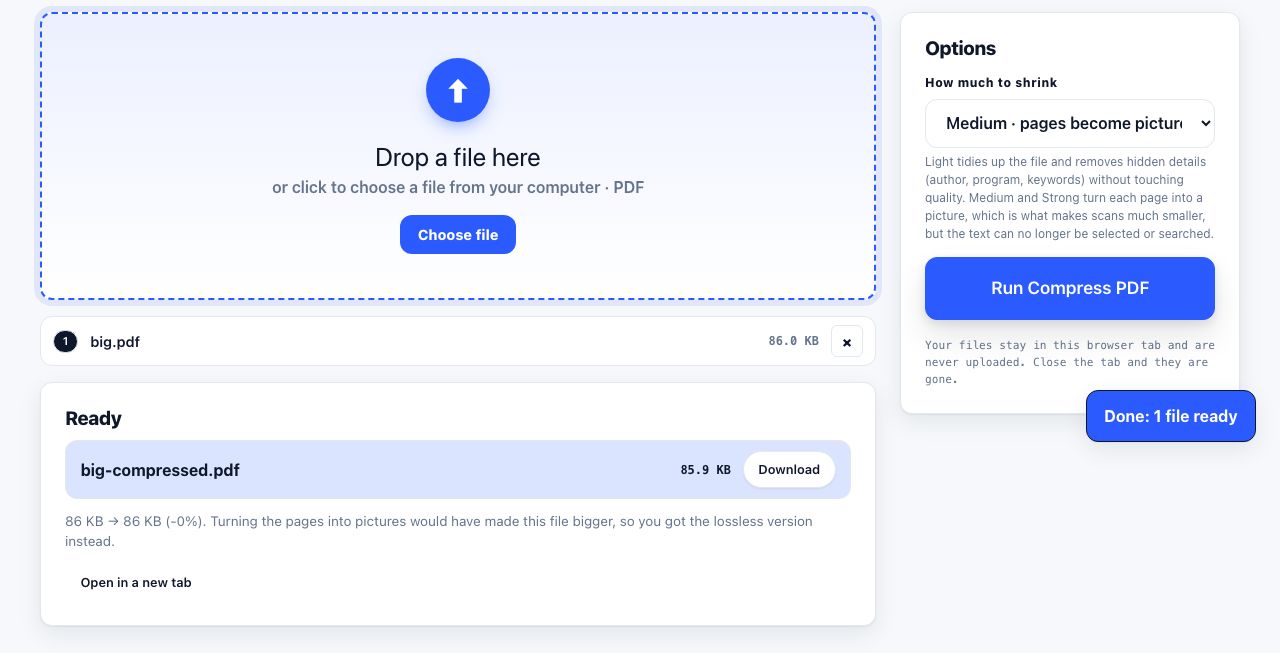
To preserve selectable text with PrintxPDF, choose Light. Medium and Strong render pages as images and may reduce detail. The compressor has no custom DPI control; change scan resolution in scanner or image software, keep the original, and compare the result.
See the tools in action
"Without losing quality" means two different things depending on what is inside your PDF, and most compression advice confuses them. A text document and a scanned document need opposite treatment.
What lossless actually means in a PDF
Lossless is a precise technical claim: decompress the result and you get the original bytes back. In PDF terms, only a handful of operations qualify.
| Operation | Truly lossless | What it costs you |
|---|---|---|
| Font subsetting | Yes | Nothing, unless someone later edits the text and needs a missing glyph |
| Object streams + compressed xref | Yes | Nothing. Requires PDF 1.5 or later |
| Removing unreferenced objects | Yes | Nothing. Removes only data no page points to |
| Re-Flate uncompressed streams | Yes | Nothing |
| Deduplicating repeated images | Yes | Nothing |
| Re-encoding PNG-style images with Flate | Yes | Nothing |
| Downsampling images | No | Pixels, permanently |
| JPEG re-encoding | No | Detail around edges, permanently |
| Flattening forms and annotations | No | Editability of the fields |
| Rasterising pages to images | No | The entire text layer and all searchability |
The last row is the trap. Some "compressors" convert every page to a JPEG and wrap the images back in a PDF. The file gets dramatically smaller and looks fine at 100 percent zoom, but the text is now a picture: unsearchable, unselectable, unusable for screen readers. Always press Ctrl+F on the result and search for a word you can see on screen.
Text documents: lossless is usually enough
A PDF exported from Word, Google Docs or LaTeX is mostly vector text and a few images. There are no pixels to throw away, so the entire saving comes from structure. Realistic expectations:
- A clean 20-page report exported today: 5-15 percent. It was already efficient.
- The same report after twelve rounds of edits and comments: 30-60 percent, because incremental saves left old revisions inside the file.
- A document embedding a full CJK or large icon font: can be dramatic, since subsetting a 12 MB font down to the glyphs actually used is a single huge win.
- A document assembled by merging ten sources: 20-40 percent, because deduplication collapses the ten copies of the same logo into one.
Scans: pick a DPI and accept the trade
A scanned page is a picture. Reducing its pixels can save space but loses detail. The right resolution depends on the destination and smallest text. The DPI table below is general scanning guidance, not a setting in PrintxPDF's compressor.
| DPI | Readable on screen | Readable printed | OCR accuracy | Verdict |
|---|---|---|---|---|
| 600 | Yes | Yes, excellent | Excellent | Overkill unless archiving or scanning tiny print |
| 300 | Yes | Yes | Excellent | The safe default when the file will be printed |
| 200 | Yes | Good | Good | Best balance for text scans destined for email |
| 150 | Yes | Acceptable at body-text sizes | Marginal | Fine for reading, risky if you still need to OCR |
| 96 | Small text softens | No | Poor | Previews only |
| 72 | Visibly blurry | No | Fails | Do not use for documents |
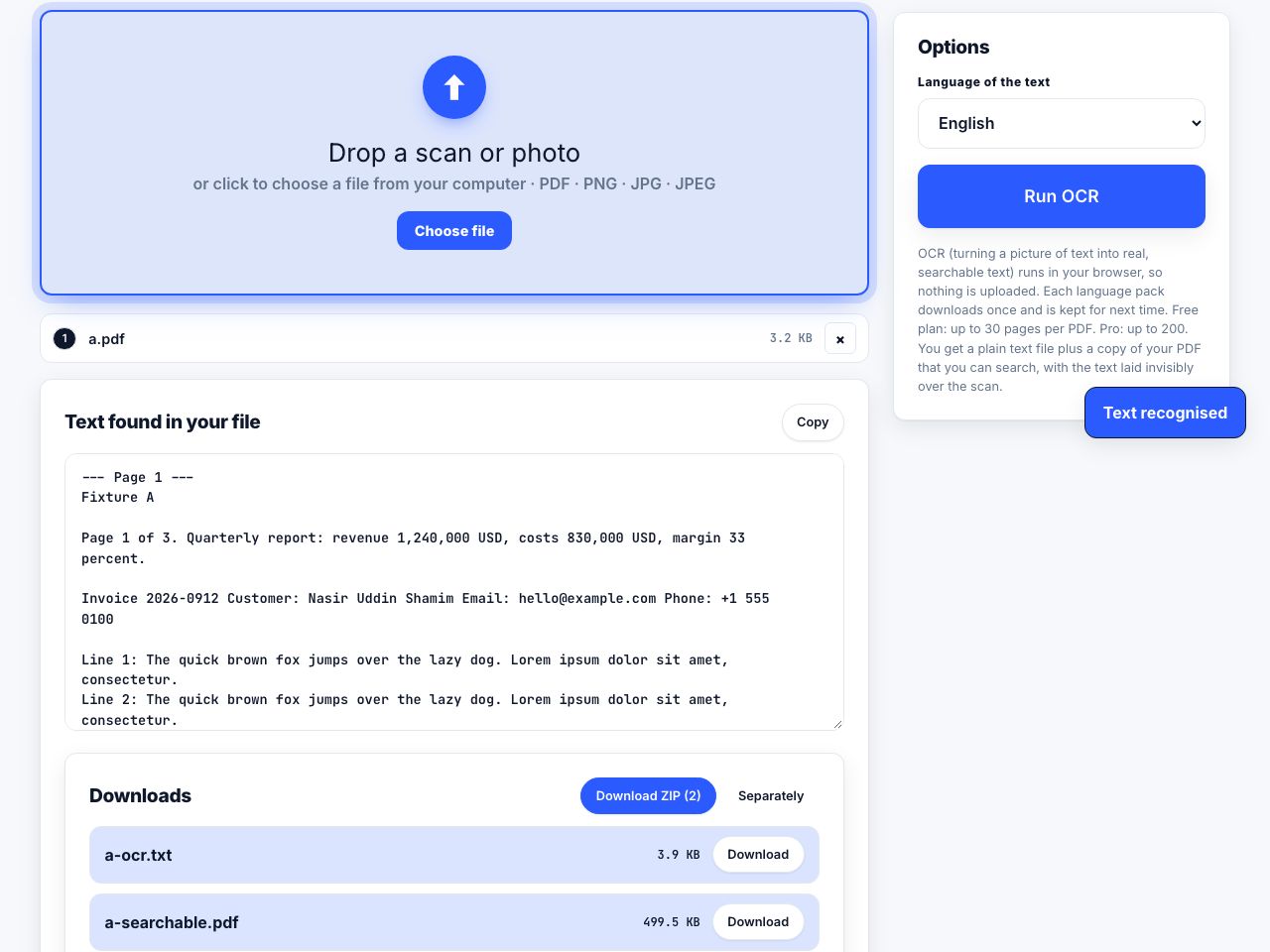
If the PDF needs OCR, start with a clear source scan and run OCR. Then choose Light in PrintxPDF to keep the searchable text layer. Medium and Strong turn pages into images, so they remove selectable and searchable text. Check the result with Ctrl+F and keep your original. See how to OCR a scanned PDF.
The colour mistake that costs the most
Most people scan black text on white paper in 24-bit colour because that is the scanner default. That stores three channels for a page that has one channel of information. Two better options:
- Greyscale (8-bit), one third of the data, keeps the soft edges that make text look natural, and handles pencil marks, stamps and signatures well. This is the right default for scanned contracts.
- Bitonal (1-bit), one twenty-fourth of the data. With CCITT Group 4 or JBIG2 encoding, a full page of text can be 20-60 KB. Perfect for clean printed text; terrible for anything with photographs, shading or a coloured letterhead.
A safe procedure
- Keep the originalCopy the file before you touch it. Everything below is reversible only if you still have the source.
- Choose LightIn Compress PDF, choose Light. It does not rasterize pages and keeps text selectable. Note the new size; if it meets your needs, stop here.
- Decide the destinationA screen-only copy may need less resolution than a print or OCR copy. This tool does not change DPI, so set resolution when scanning or preparing an image copy.
- Downsample onceIf scanner or image software offers resampling, work from the original scan and export a separate copy. Recompressing lossy images repeatedly can add visible artefacts.
- Inspect at 400 percentZoom in on the smallest text and on any diagonal line or fine table rule. Artefacts appear there first, long before they show in body text.
- Check the text layer survivedCtrl+F for a visible word. If it is not found, the tool rasterised your pages, discard the result.
Use Light to keep text selectable; keep the original before trying image-based compression.
Compress PDF →If Light does not reduce the size enough and image-based compression would hurt readability, split the file or use a sharing link. See reducing a PDF for email for current provider guidance.
Frequently asked questions
Is there such a thing as truly lossless PDF compression?
Yes. Some structural operations do not alter visible page content, but savings depend on the PDF and the tool. PrintxPDF's Light preset does not rasterize pages and does not guarantee a fixed reduction percentage.
What DPI should I compress a PDF to?
It depends on the smallest text and intended use. 150 to 300 DPI can be a useful scan range, but print and OCR requirements vary. PrintxPDF does not have a DPI selector; change scan settings before creating the PDF.
Will compressing a PDF break the OCR text?
It depends on the preset. Light does not rasterize pages, so text stays selectable. Medium and Strong turn each page into an image, which removes selectable text. OCR first if needed, choose Light, and check with Ctrl+F before sharing.
Why does my compressed PDF look blurry when I zoom in?
An image-based preset may reduce fine detail, especially when you zoom in. Keep the original and compare at the size the recipient will read or print. The tool does not let you select an exact DPI.
Does compressing a PDF twice make it smaller?
A second lossless pass gains nothing. A second lossy pass makes it smaller but stacks JPEG artefacts, and the damage compounds visibly. Always compress the original once at the setting you actually need.