Why is my PDF file so large? 8 reasons

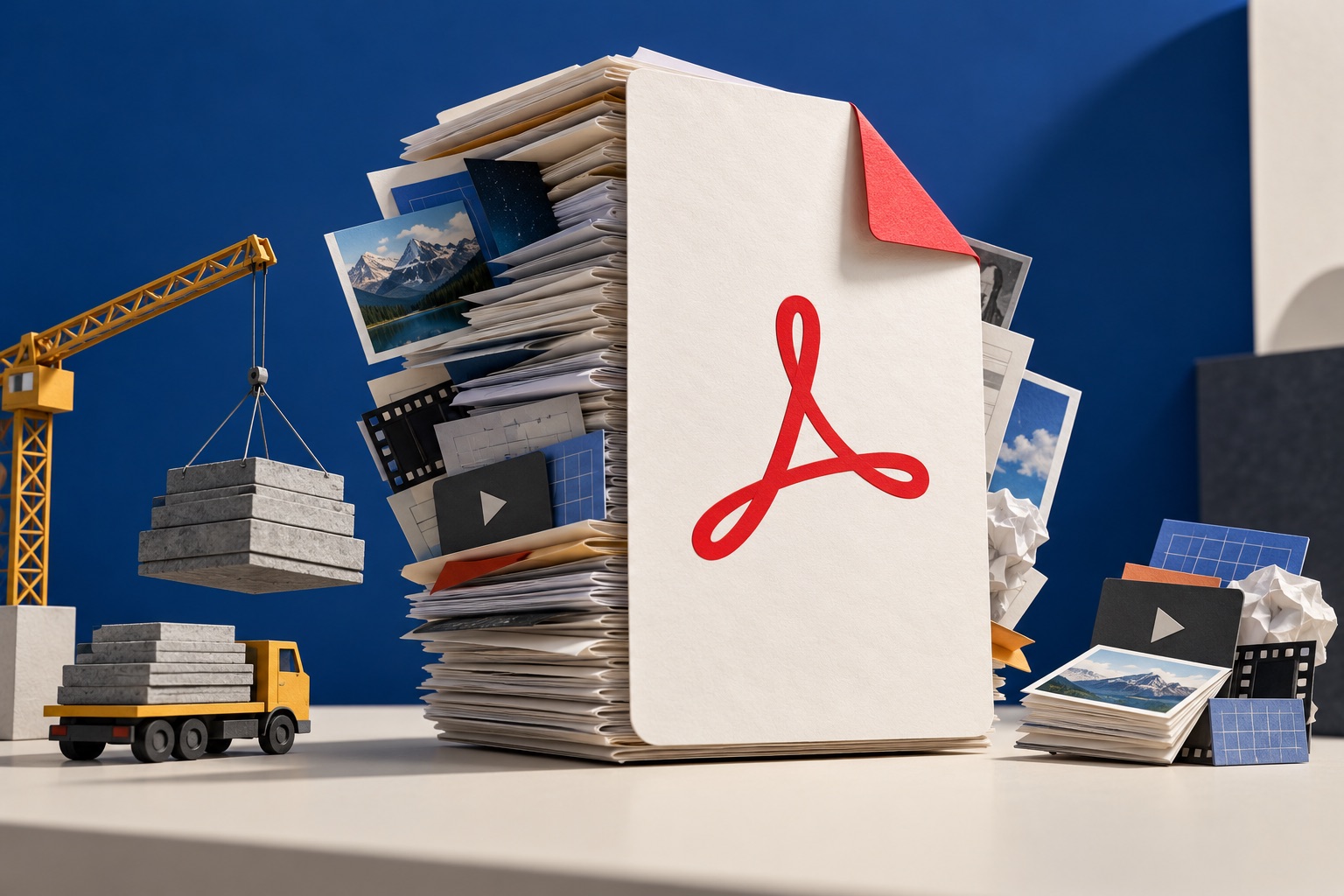
A PDF is usually large for one of eight reasons: it is a scan stored as images, images are embedded at full resolution, fonts are embedded whole instead of subset, resources are duplicated per page, saves were incremental, images are cropped only visually, forms and attachments are attached, or colour profiles and transparency are heavy.
See the tools in action
A four-page memo should be about 100 KB. If yours is 40 MB, something specific is wrong, and it is almost always one of the eight causes below. Work down the list, the first three account for the large majority of oversized files.
1. It is a scan, not a document
The single most common cause. If your PDF came from a scanner, a copier or a phone camera, every page is a photograph. A 600 DPI colour scan of one A4 page is 4960 × 7016 pixels, 35 megapixels, which is more than most cameras produce. Twenty pages of that is easily 100 MB.
Fix: downsample to 150-200 DPI and switch colour scans of black text to greyscale. On the scanner itself, set 200 DPI greyscale as your default for documents. Reserve 300 DPI colour for photographs and artwork.
2. Images are embedded at their original resolution
You dropped a 6000-pixel-wide photo from your phone into a Word document and scaled it to two inches. On screen it looks like a small picture; inside the file it is still 6000 pixels wide, which works out to 3000 DPI. You are storing a hundred times more image data than the page can ever show.
Fix: resize images to their display size before placing them. A 2-inch-wide image at 300 DPI needs 600 pixels. In Word, Picture Format → Compress Pictures → 220 ppi does this for the whole document at once.
3. Fonts are embedded in full instead of subset
PDF embeds fonts so the file renders identically everywhere. Well-behaved generators embed only the glyphs used, a subset. Badly-behaved ones embed the entire font file. A Latin font is 100-500 KB, but a CJK font covering Chinese, Japanese and Korean can be 5-25 MB. Embed three of those in full and you have a 60 MB file with nothing but text in it.
Fix: use a PDF optimizer that explicitly supports font subsetting, then inspect font properties in a desktop PDF reader. PrintxPDF's Light preset does not perform font subsetting.
4. The same resource is stored many times
A letterhead logo placed on all 80 pages should be one object referenced 80 times. Some generators, and almost every "merge these files" workflow that does not deduplicate, store 80 separate copies. The same happens with background images, watermarks and repeated table graphics.
Fix: deduplication is part of a proper structural compression pass. It is also why a merged document is often much larger than the sum of its parts until you compress it. See merging PDF files.
5. Every save was an incremental update
PDF allows a writer to append changes to the end of the file rather than rewriting it. This is fast and it preserves digital signatures, so annotation tools use it constantly. The cost is that every previous version stays in the file. A document annotated across thirty sessions can carry twenty-nine dead copies of itself.
Fix: a full rewrite, sometimes called "Save As" rather than "Save", or "linearise", collapses the history into a single current version.
Old revisions are a privacy problem too. If someone redacted a paragraph and saved incrementally, the original text may still sit in an earlier revision. Remove metadata and flatten before sharing anything sensitive.
6. Images are cropped visually, not actually
Cropping in InDesign, PowerPoint or Word usually sets a visible frame over the image rather than deleting the hidden pixels. Crop a 20-megapixel photo down to a thin banner and the file still carries all 20 megapixels. The same applies to images placed partly off the edge of the page.
Fix: in Word and PowerPoint, Compress Pictures has a "Delete cropped areas of pictures" checkbox. Tick it. In InDesign, use Package or export with image downsampling enabled.
7. Forms, annotations, attachments and scripts
- Form fields carry appearance streams, a stored rendering for each visual state of each field. A 200-field form can add several megabytes.
- Embedded file attachments. PDF can carry arbitrary files inside it. A spreadsheet attached to a report is invisible in the page view and fully counted in the file size.
- Annotation appearance streams from highlighting and commenting tools.
- JavaScript for form validation, plus the fonts those form fields reference.
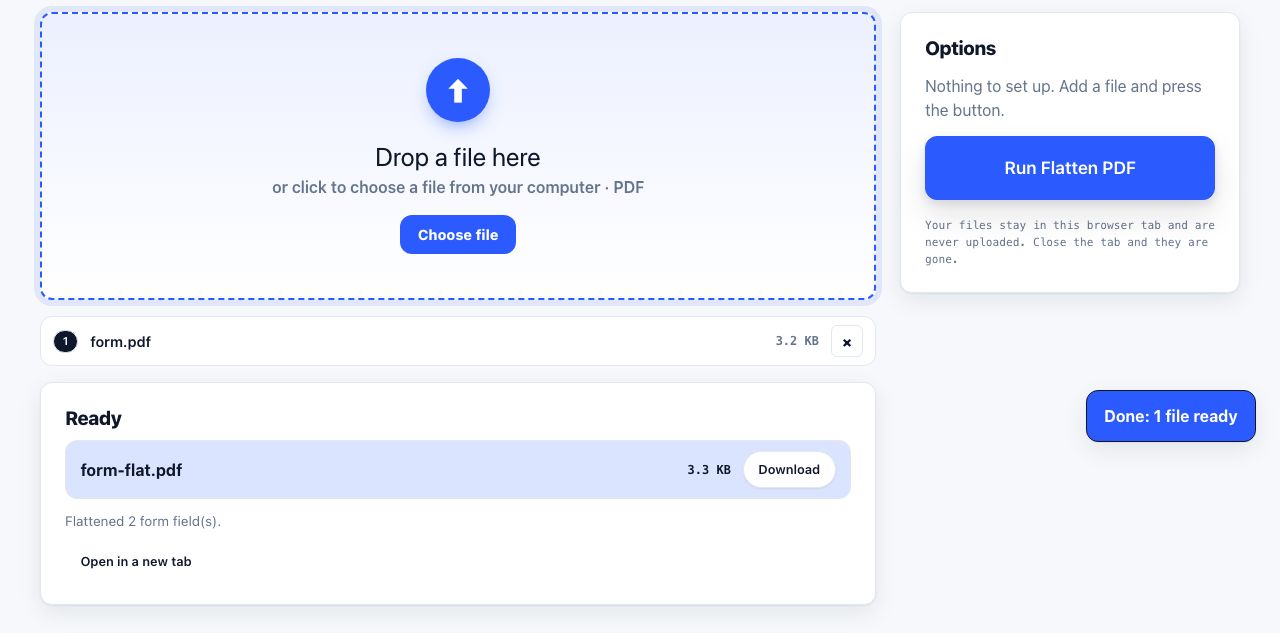
Fix: if the form is filled and finished, flatten it. Flattening bakes the field values into the page and removes the interactive layer, which usually cuts a completed form substantially and also stops anyone editing the answers.
8. Colour profiles, transparency and vector overload
Print-ready files carry weight you do not need on screen: embedded ICC colour profiles for CMYK output, transparency groups flattened for older viewers, and vector artwork with tens of thousands of paths. A detailed map or CAD drawing exported as vectors can be 30 MB with no images at all.
Fix: export for screen rather than for press, which drops the CMYK profiles. For a monstrous vector illustration, converting that one page to a 300 DPI image is often a 95 percent saving with no visible difference on screen.
Diagnosing your own file
- Try to select textOpen the PDF and drag across a paragraph. If nothing highlights, it is a scan, cause 1, and you can stop reading here.
- Divide size by page countUnder 100 KB per page is a normal text document. 100 KB - 1 MB usually means images. Over 1 MB per page is a scan or a full-resolution photo problem.
- Check the fontsFile → Properties → Fonts in any full PDF viewer. Anything not marked "Embedded Subset" is cause 3.
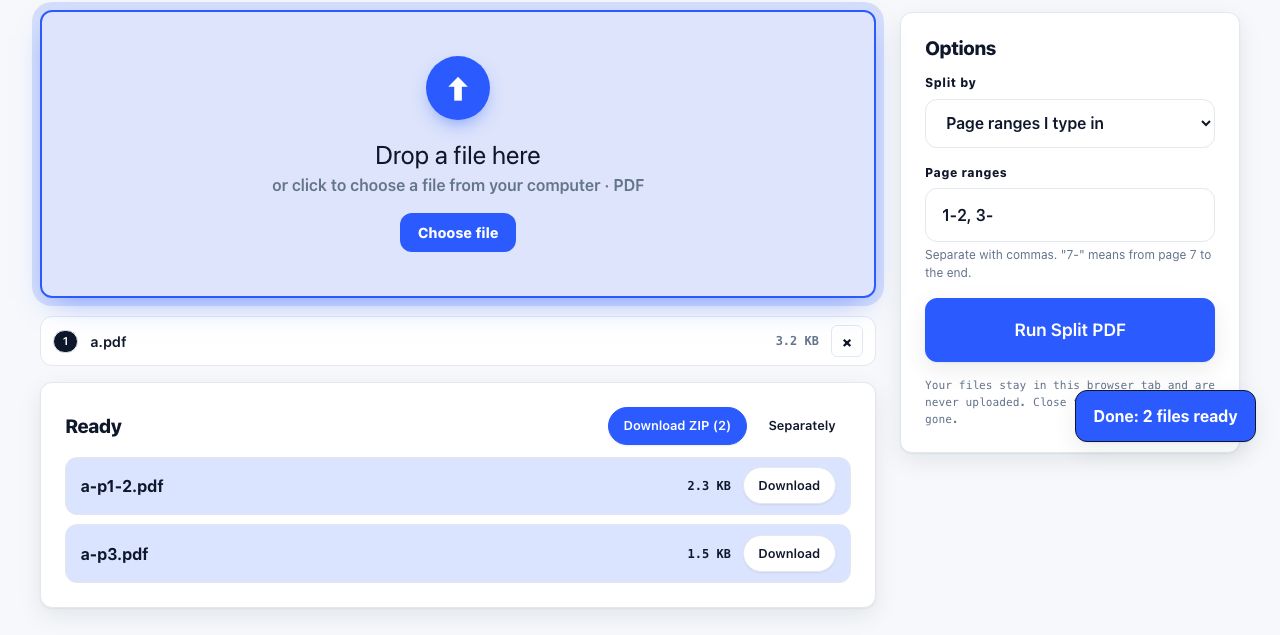
- Look for a rogue pageSplit the file and compare the parts. One 25 MB page among forty 80 KB pages points straight at a single oversized image or vector drawing.
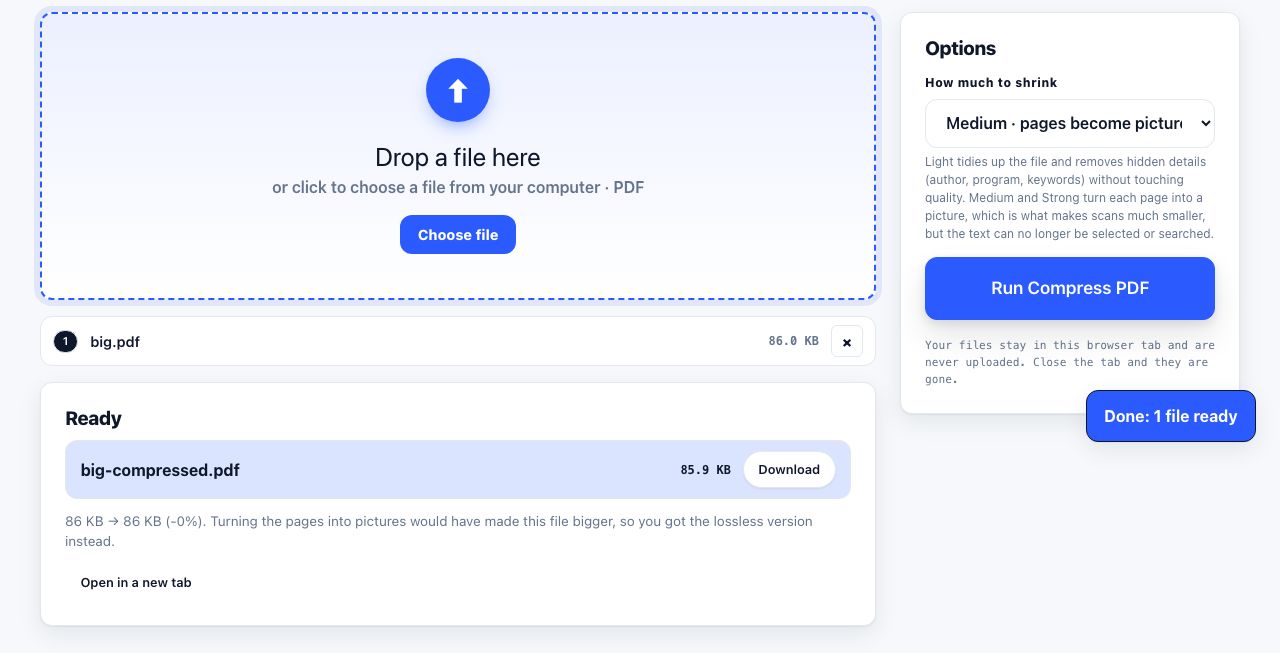
- Run a lossless compression passWhatever the compressor removes without touching images was structural waste, causes 3, 4 and 5.
| Symptom | Likely cause | Fix |
|---|---|---|
| Text cannot be selected | Scanned pages (1) | Downsample to 150-200 DPI, use greyscale |
| Small file grew after editing | Incremental saves (5) | Save As, or run a structural rewrite |
| Text-only file is 40 MB | Unsubsetted fonts (3) | Structural compression with font subsetting |
| Merged file bigger than its parts | Duplicated resources (4) | Deduplicating compression pass |
| One page is enormous | Full-resolution or uncropped image (2, 6) | Resize the image, delete cropped areas |
| Filled form is huge | Field appearance streams (7) | Flatten the form |
Start with a lossless pass, it tells you how much of your problem is structural.
Compress PDF →Frequently asked questions
Why is my PDF bigger than the Word document it came from?
Word stores images compressed and fonts by reference. A PDF embeds the fonts and often stores images re-encoded at full resolution so the file renders identically everywhere. Use Word Compress Pictures at 220 ppi before exporting to close most of the gap.
Why did my PDF get bigger after I added a comment?
Annotation tools save incrementally, appending the change to the end of the file instead of rewriting it. Each session adds another layer. Doing a Save As, or running a structural compression pass, collapses them back into one version.
How big should a normal PDF be?
Roughly 20-100 KB per page for text with a few images. 100 KB - 1 MB per page for image-heavy documents. Over 1 MB per page almost always means scanned pages or photos embedded at their original camera resolution.
Does deleting pages reduce PDF file size?
Only if the tool rewrites the file. Some editors mark pages as removed but leave the objects in place. Delete the pages, then run a compression pass so the orphaned objects are actually dropped.
Can a PDF be large with no images at all?
Yes. Fully embedded CJK fonts, complex vector artwork such as maps or CAD exports, hundreds of form fields with appearance streams, and embedded file attachments can all produce a very large PDF with nothing but text and lines on the page.